
Frozen Shoulder Exercises at Home
Gentle, regular movement can help maintain shoulder mobility during frozen shoulder, but exercises should not be forced—especially during the painful “freezing” stage. A physiotherapist can adjust the intensity to your stage, movement restriction, and pain response.
Gentle Exercises
Perform these exercises slowly and comfortably, once or twice daily unless your physiotherapist advises otherwise.
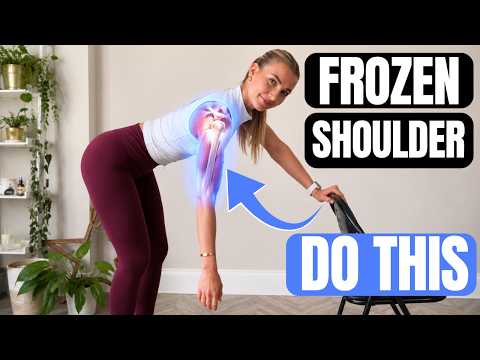
Pendulum exercise
- Lean forward with your unaffected hand supported on a table or chair.
- Let the affected arm hang loosely.
- Gently swing it forward and backward, side to side, and in small circles.
- Continue for about 30 seconds in each direction.
The movement should come from your body, not forceful shoulder muscles.
Table slide
- Sit facing a table with your affected hand resting on a towel.
- Slowly slide the hand forward while leaning your body slightly toward the table.
- Stop at a comfortable stretch.
- Hold for 10–15 seconds, then return slowly.
- Repeat 5–10 times.
This is often easier than raising the arm unsupported.
Finger walk
- Face a wall and place the fingers of your affected arm against it.
- Walk your fingers upward gradually.
- Stop before sharp pain or a strong shoulder shrug develops.
- Slowly walk the fingers back down.
- Repeat 5–10 times.
Finger walking is commonly used to gradually improve overhead reach.
Assisted shoulder raise
- Lie on your back or sit comfortably.
- Hold the affected arm with your unaffected hand, or hold a light stick with both hands.
- Use the unaffected arm to gently guide the affected arm upward.
- Hold the comfortable end position for 5–10 seconds.
- Repeat 5–10 times.
Do not push through a sharp or pinching pain.
Cross-body stretch
- Bring the affected arm gently across your chest.
- Use the opposite hand to support it above the elbow.
- Hold a mild stretch for 15–20 seconds.
- Repeat 3–5 times.
This exercise should feel like a gentle stretch behind the shoulder, not a forceful pull.
Towel stretch
- Hold a towel behind your back with both hands.
- Use the unaffected arm to gently guide the affected hand upward or across the lower back.
- Hold only a mild stretch.
- Repeat 5–10 times.
Avoid aggressively pulling the arm behind your back, particularly if this movement is very painful.
Pain Guidelines
A mild stretching sensation may be acceptable, but stop and reduce the intensity if you experience:
- Sharp or catching pain.
- Increasing pain that lasts for hours afterward.
- Marked swelling or warmth.
- New weakness, numbness, or tingling.
- Dizziness or feeling unwell.
Do not bounce, jerk, or force the shoulder. During a painful early stage, gentler movements may be more suitable than aggressive stretching. Evidence-based patient guidance recommends contacting a healthcare professional if symptoms worsen or fail to improve over time.

When to Get Assessed
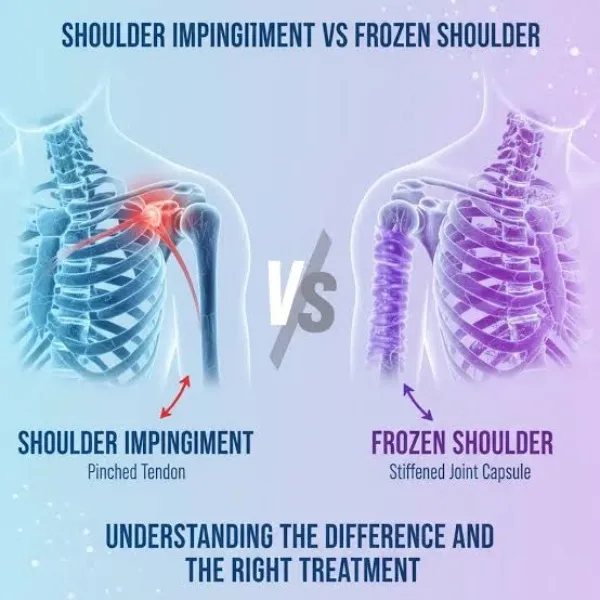
Arrange a physiotherapy or medical assessment if your shoulder pain is severe, your movement is rapidly worsening, you cannot use the arm, or symptoms began after a fall or other injury. Similar symptoms can occur with rotator-cuff problems, arthritis, nerve irritation, or other conditions, so not every stiff shoulder is frozen shoulder.
Seek urgent care for chest pain, breathing difficulty, sudden arm weakness, a visibly deformed shoulder, fever with a hot swollen joint, or new neurological symptoms.
Simple Home Routine
A gentle starting routine could be:
- Pendulum movements: 30 seconds each direction.
- Table slides: 5–10 repetitions.
- Finger walks: 5–10 repetitions.
- Assisted shoulder raises: 5–10 repetitions.
- Cross-body stretch: 3 repetitions of 15–20 seconds.
The number of repetitions should be adjusted to your symptoms and stage of recovery. Frozen shoulder often improves gradually over a prolonged period, so consistent, comfortable movement is generally more appropriate than trying to force rapid gains.
This information is for general education and does not replace an examination or individual exercise prescription by a qualified healthcare professional.
Keywords